

In a world changing at an unprecedented pace, and where the challenges facing companies and institutions are increasing, innovation has become an indispensable necessity. And since innovation doesn’t happen by chance, Design thinking Today it has become one of the most important methods that help in turning problems into opportunities, and thus building innovative ideas that make a real difference in the lives of users.
In addition, it provides a practical framework that helps organizations plan and execute in a smarter and more flexible way.
It is a creative approach to problem-solving. It relies primarily on understanding consumers and deeply analyzing their needs. Although the concept originated in the world of design, it has gradually become an essential part of modern corporate strategies.
Moreover, Design thinking is characterized by its flexibility, making it suitable for various sectors such as education, health and technology.
What is design thinking and why has it become a major driver of innovation?
Before delving into the details of the application, it’s essential to understand the essence of design thinking. Simply put, it’s a methodology that places the user at the heart of the creative process. This distinguishes it from traditional approaches that often stem from internal assumptions or corporate perspectives not grounded in the needs of the target audience.
Furthermore, design thinking is based on integrating creativity and analysis, allowing complexities to be transformed into simple and practical solutions. Therefore, it is adopted by companies that seek sustainable innovation rather than short-term, reactive innovation.
On the other hand, design thinking is practical and applicable in most sectors, because it does not require advanced technical knowledge, but rather an open mind and a genuine desire to understand customers.
The importance of design thinking in the modern business world
1. Improve the user experience systematically
Today, companies strive to deliver a seamless experience, from the initial interaction to after the service purchase. Because customers are more discerning and compare alternatives, a compelling experience has become a key factor for success. This is where design thinking comes in as a savior, allowing companies to understand the actual user journey and thus develop solutions based on reality, not expectations.
Furthermore, design thinking helps to identify weaknesses in the customer journey, leading to overall improvement that raises satisfaction and loyalty rates.
2. Turning challenges into innovation opportunities
Some companies often view challenges as obstacles, while design thinking sees them as genuine opportunities for innovation. When a problem is analyzed thoroughly, it becomes clear that behind every problem lies an unmet need, thus revealing an opportunity for a new solution. Therefore, many leading companies rely on this type of thinking when facing crises.
3. Deepening the culture of internal creativity
By encouraging collaboration among teams, design thinking helps build a stimulating environment. Since better ideas come from interaction rather than isolation, the design thinking approach fosters teamwork and increases employee engagement.
In addition, the organization becomes more adaptable, which is what any company needs in a rapidly changing market.
4. Reducing risks through modeling and testing
Instead of investing time and money in an idea that might later fail, design thinking allows for testing the solution on a small scale. As a result, flaws are identified and improved before the official launch. This approach reduces risk and increases the likelihood of success.
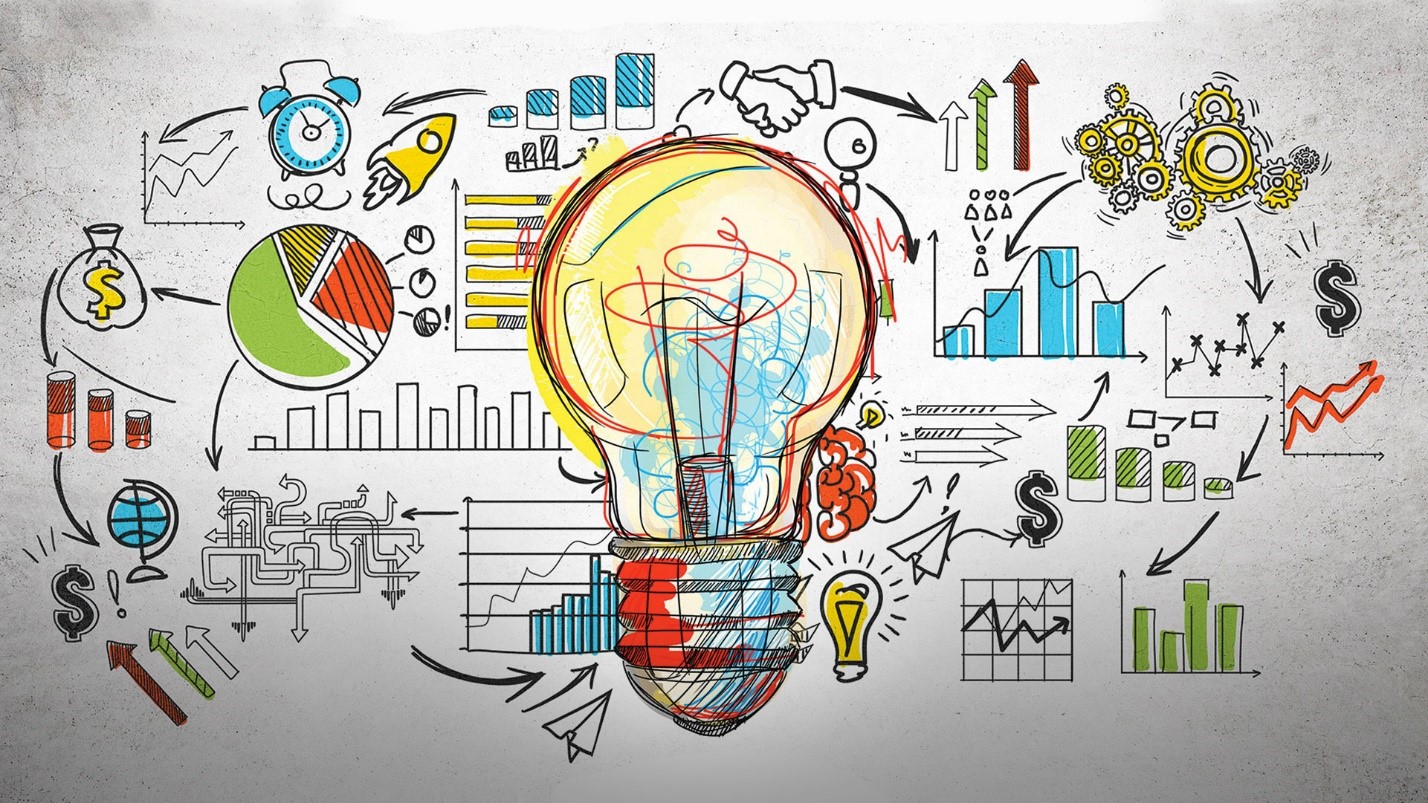
Stages of design thinking: How are innovative ideas built?
To understand the innovation process practically, we must go through five basic stages. Although their order may seem linear, design thinking is flexible, and we can move between stages continuously as needed.
Phase 1: Empathy with users
At this stage, the team focuses on understanding users’ feelings, needs, concerns, and aspirations. In addition to using analytical tools, direct communication plays a crucial role. Therefore, companies rely on interviews, observations, and customer journey mapping.
Because of this empathy, companies succeed in providing solutions that the user feels were made specifically for him.
Phase Two: Identifying the Problem
After data collection comes the identification phase. Here, the information is analyzed to pinpoint the real problem. Although this step may seem simple, it is the most impactful. A well-defined problem leads to precise and effective solutions.
Furthermore, this step helps guide the team onto a clear path, reducing distractions.
Phase Three: Generating Ideas (Creative Brainstorming)
At this stage, creativity runs at full speed. The team is encouraged to propose as many ideas as possible, without restrictions or judgment. As a result, ideas that may seem strange at first emerge, but which represent the seeds of successful innovations later on.
On the other hand, this method leads to a diversity of ideas, which enhances the chances of reaching unconventional solutions.
Fourth stage: Prototypes
After selecting a number of viable ideas, the team transforms them into simple prototypes. These prototypes might be drawings, models, initial application pages, or even a pilot workshop.
Because the goal is understanding, not perfection, this stage helps to uncover weaknesses from the beginning.
Phase Five: Testing and Improvement
Here, prototypes are tested on a sample of users to gather genuine feedback. Based on this, the idea is refined and retested. As a result, the final solution becomes more mature and ready.
Interestingly, companies that rely on this stage make their decisions based on real data, not predictions.
Applications of design thinking in different sectors
1. In the technology sector
New technology companies rely on design thinking to create applications characterized by simplicity and clarity. For example, companies like Apple use this methodology to offer products focused on streamlining and ease of use.
2. In the health sector
By redesigning the patient journey, some hospitals have been able to improve the waiting process, reduce psychological stress, and increase the efficiency of the medical team.
3. In the education sector
Adopting design thinking has led to the development of more interactive teaching methods. As a result, students have become more motivated and their ability to learn independently has increased.
4. In marketing
Design thinking helps marketers understand customer behavior, and therefore design effective campaigns based on real needs rather than assumptions.
How do companies adopt design thinking?
1. Ongoing employee training
Innovation doesn’t happen by chance. Therefore, successful companies rely on training their teams, which fosters a culture of creativity.
2. Encouraging a collaborative environment
When employees from different disciplines are brought together in a single session, amazing results emerge. Diversity generates unexpected ideas.
3. Use the appropriate tools
Examples include mind maps, empathy maps, templates, and Journey Mapping templates. Additionally, these tools facilitate the process and accelerate completion.
4. Focus on the user, not the process.
Instead of making plans inside closed offices, we should go out into the market to learn about customer opinions.
The impact of design thinking on modern marketing strategies
It’s important to understand that marketing is no longer just about advertising messages. It’s now about the customer experience. Therefore, design thinking has proven to be an effective tool for building successful marketing plans. For example, marketers can use brainstorming sessions to generate creative messages. Additionally, they can use prototypes to test campaigns before launching them.
As a result, success rates increase significantly.
How does Reins help you?
If you want to elevate your company and build exceptional products and experiences based on customer needs, Reins has the expertise to implement design thinking within your organization.
We offer training programs, innovation consulting, prototyping, and customer experience improvement in a practical and scientific way.