

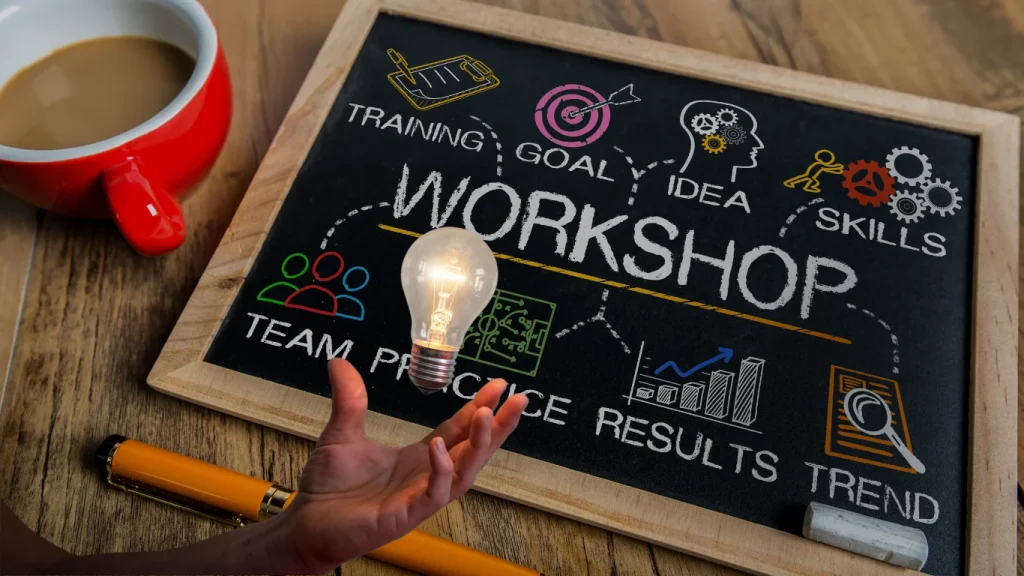
In a world undergoing rapid changes in business, education, and entrepreneurship, traditional learning and development methods are no longer sufficient to meet modern challenges. For this reason, workshops have increasingly become one of the most important tools used in skills development and capacity building, as well as in improving organizational and individual performance. However, despite this development, a fundamental question remains that cannot be ignored.
The question is: What is the difference between traditional workshops and innovative workshops?
Which one is ultimately best suited to achieving your goals?
Accordingly, this comprehensive guide provides an in-depth review of the differences between traditional and innovative workshops in terms of concept, method, tools used, as well as the role of participants, expected outcomes, and, based on that, the benefits that can be achieved from each type.
Firstly: What are workshops? And why are they important?
Workshops are training or interactive sessions designed to achieve a specific goal within a relatively short period of time. Their purpose might be:
- Transfer of specific knowledge or skill
- Solving a specific problem
- Developing new ideas
- Improving the performance of a team or organization
The importance of workshops lies in the fact that they combine learning and application, and provide a suitable environment for interaction, discussion, and exchange of experiences.
secondly: Traditional workshops – concept and method
Definition of traditional workshops
Traditional workshops are the classic training model, where the trainer or expert plays a central role in transferring knowledge to the participants. This type of workshop relies on a direct teaching style, much like academic lectures.
Characteristics of traditional workshops
1. Focus on theoretical education
Traditional workshops focus primarily on explaining concepts and theories, relying heavily on pre-packaged knowledge. Practical application is often limited or secondary.
2. Limited interaction
In this type of workshop:
- The coach will be the main speaker.
- The participants’ role is limited to listening and asking a limited number of questions.
- Interaction between the participants themselves decreases
3. Content stability
The workshop content is prepared in advance according to a standardized template, without any real customization to suit the different backgrounds of the participants or their practical challenges.
4. Tools used
Traditional workshops rely on simple tools such as:
- PowerPoint presentations
- Printed materials
- The blackboard or oral explanation
Results of traditional workshops
- Building a basic knowledge base
- Improving theoretical understanding of the subject
- Suitable for introducing concepts or training beginners
Despite its importance, this type may not be sufficient in environments that require innovation, problem-solving, and decision-making.
Third: Innovative workshops – a modern methodology for creative thinking
Definition of innovative workshops
Innovative workshops are interactive experiences focused on stimulating creativity, collaboration, and finding practical solutions to problems. The goal is not simply to transfer knowledge, but to generate new, applicable ideas.
Characteristics of innovative workshops
1. Interaction and teamwork
Innovative workshops rely on teamwork, where:
- Everyone participates in the discussion
- Ideas are freely exchanged
- Each participant is viewed as an active element in building the solution.
2. Focus on practical application
One of the most prominent features of this type is the rapid transition from idea to application through:
- Building prototypes (Prototypes)
- Testing solutions
- Analyzing and developing the results
3. Using modern tools and technologies
Innovative workshops include tools such as:
- Design Thinking
- Brainstorming
- Mind mapping
- Role Playing
4. Flexibility and customization
The workshop is designed based on:
- Participants’ needs
- Nature of the challenge or problem
- Organizational or team goals
Results of the innovative workshops
- Generating innovative and actionable ideas
- Enhancing critical and creative thinking skills
- Improving cooperation and teamwork
- Accessing practical and sustainable solutions
Fourth: The difference between traditional workshops and innovative workshops
1. Differences in terms of objectives
- Traditional workshops: aim to transfer knowledge and build basic skills
- Innovative workshops: aim to solve problems and create new solutions
2. Differences in style
- Traditional: Instructor explains – participants listen
- Innovation: Facilitator guides – participants innovate
3. Differences in terms of the tools used
- Traditional: presentations, static content
- Innovation: Interactive tools, prototypes, group activities
4. Differences in terms of the role of the participants
- Traditionalism: A relatively negative role
- Innovation: An active and pivotal role
Fifth: The benefits of innovative workshops compared to traditional ones
1. Practical and applicable solutions
Innovative workshops help transform ideas into clear action plans, rather than just theoretical concepts.
2. Stimulating creativity and thinking outside the box
It provides a safe environment for experimenting with new ideas without fear of failure.
3. Strengthening team spirit
It contributes to building stronger relationships between participants through joint cooperation.
4. Increased enthusiasm and participation
Interactive activities make the experience more fun and impactful.
Sixth: How to choose the most suitable workshop type
The choice between traditional and innovative workshops depends on several factors, including:
- Nature of the objective (educational or innovative)
- Participants’ level of experience
- The nature of the challenges facing the organization
- Time and available resources
If the goal is learning and knowledge transfer, then traditional workshops are suitable.
If the goal is innovation and problem-solving, then innovation workshops are the ideal choice.

Seventh: Implementing innovative workshops within institutions
1. Clearly define the goals
Goals should be specific, measurable, and linked to real challenges.
2. Choosing the right tools
Using modern methodologies that are appropriate to the nature of the problem.
3. Facilitator training
The facilitator’s role is essential to the success of the workshop, as they guide the discussion and motivate the participants.
4. Monitoring results and evaluating performance
Analyzing outputs and measuring impact to ensure continuous improvement.
Frequently Asked Questions (FAQ)
What is the main difference between traditional and innovative workshops?
The main difference lies in the objective and the method; traditionalism focuses on transferring knowledge, while innovation focuses on solving problems and generating ideas.
Can traditional workshops be combined with innovative ones?
Yes, the two methods can be combined to achieve the best results, especially in long training programs.
What fields are suitable for innovative workshops?
It is suitable for fields such as entrepreneurship, marketing, product development, digital transformation, and change management.
Are innovative workshops suitable for all organizations?
Yes, provided that it is designed in a way that is compatible with the organization’s culture and objectives.
Workshops, both traditional and innovative, play a pivotal role in the development of individuals and organizations. With the increasing need for creativity and innovation in a rapidly changing world, innovative workshops have become an indispensable strategic tool for achieving sustainable growth.
If you are looking for the design and implementation of professional workshops that combine creativity, practicality, and results, Reins provides you with integrated solutions tailored to meet your needs and achieve your goals.