


In an era of accelerating innovation and fierce competition among companies, it has become essential to seek new methodologies that enable organizations to create genuine value for their customers. Among the most important of these methodologies are design thinking workshops, which have become an integral part of the innovation tools within successful companies. Because markets are constantly evolving, the use of design thinking is no longer a secondary option, but rather a necessary strategic approach for developing competitive products and services.
Accordingly, this article explores everything related to design thinking workshops, from their concept to their practical applications.
What are design thinking workshops?
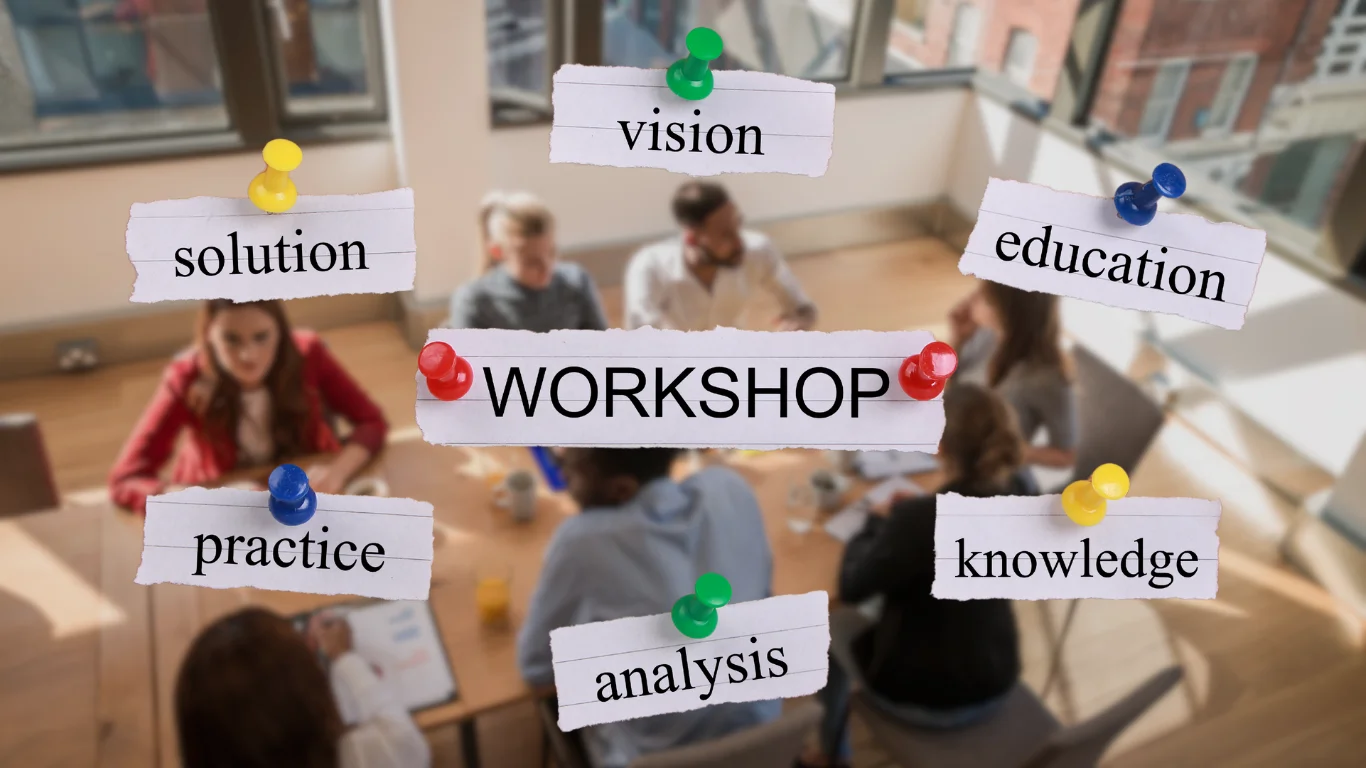
Above all, design thinking workshops can be described as interactive sessions based on a structured approach aimed at understanding user needs and developing innovative solutions to existing problems. While many believe they are simply brainstorming sessions, the reality is much more complex; they rely on a methodology that blends rigorous analysis with open-ended creativity.
In addition, these workshops offer an opportunity to break down barriers between team members, bringing together specialists from various fields such as design, marketing, development, and customer service. This diversity transforms the workshop into an environment rich with different ideas and perspectives, ultimately leading to the development of innovative and practical solutions.
On the other hand, design thinking workshops focus entirely on the user, placing their needs and experience at the heart of the process, ensuring a solution that is as close to reality as possible and more likely to succeed.
How do design thinking workshops work? — Five key stages
To achieve genuine innovation, design thinking workshops are based on five interconnected phases. While these phases are often applied sequentially, they are flexible enough to allow for adjustments and regression when needed.
1. Empathize with users
Initially, this stage aims to gain a deep understanding of the user. Therefore, several methods are employed, such as in-depth interviews, questionnaires, direct observation of user behavior, and data analysis. Through these steps, a clear picture of the user’s feelings, motivations, and needs can be formed.
In addition, this stage helps companies get rid of preconceived notions about what the customer wants, and focus on what they need from a realistic perspective.
2. Define the problem
After data collection and analysis comes the problem definition stage, which is one of the most important stages of design thinking. Although it may seem like a simple step, it requires high precision because it determines the entire course of the subsequent process.
Therefore, framing the problem correctly helps the team focus on the real challenges rather than the superficial aspects.
3. Generating Ideas (Ideate)
At this stage, the team is encouraged to think freely. Therefore, no idea is rejected outright. On the contrary, all ideas, no matter how unconventional, are encouraged, as the goal is to broaden the scope of thinking.
In addition, tools are used to help open up new lines of thinking, such as:
brainstorming
SCAMPER
Mind maps
free thinking
Through these tools, it becomes possible to generate a large number of ideas that can be built upon later.
4. Prototype making
After selecting suitable ideas, they are transformed into simple prototypes. Therefore, the focus is on creating low-cost, easily modifiable versions. These prototypes can take the form of a drawing, a model, a digital experiment, or even a simulation.
On the other hand, prototypes help to see the idea in a tangible way, which makes it easier to make decisions about whether to develop or modify it.
5. Testing the solutions (Test)
Finally comes the testing phase, which represents the ultimate validation of the solution. During this phase, the prototype is presented to users to obtain direct feedback.
Based on these responses, the model is either modified, improved, or even reverted to an earlier stage to rethink the idea. This process ensures that the final model is truly capable of meeting customer needs.
Benefits of Design Thinking Workshops — Why Do Companies Adopt Them?
Design thinking workshops are characterized by their ability to fundamentally change the way companies think. Therefore, many global companies have adopted them as part of their innovation strategies.
1. Enhancing collective creativity
Firstly, design thinking workshops provide an opportunity for all individuals to express their ideas without fear of judgment. As a result, new ideas emerge that combine different experiences.
In addition, collaboration among team members leads to the development of more integrated and realistic solutions.
2. Reducing risks
On the other hand, early prototypes and testing help reduce the costs associated with developing unsuccessful products. Consequently, companies can save significant resources.
3. Improving the user experience
Because design thinking methodology is user-centric, the results are typically of higher quality and more effective. Therefore, the customer experience improves significantly.
4. Building a culture of innovation
In the long run, design thinking workshops contribute to creating a more creative work environment, helping the company to face challenges with greater flexibility.
5. Improve internal communication
On the other hand, Workshops contribute to strengthening teamwork between different departments, which leads to improved productivity and reduced communication problems.
Important tools used within design thinking workshops
There are a large number of tools used within workshops to ensure the process runs efficiently, the most important of which are:
1. Empathy Maps
These maps help to accurately understand the feelings, thoughts, and behaviors of users.
2. Guided brainstorming
It is used to generate many ideas in a short time, while maintaining order within the session.
3. Rapid prototyping
They are used to produce simple prototypes that give the team a chance to visually understand the idea.
4. User Stories
It helps visualize the scenarios that the user goes through.
5. Customer Journey Maps
It provides a complete view of the user experience with the product at all its stages.
Successful examples of design thinking workshops
1. In the technology sector
One of the tech giants redesigned its app interface based on a design brainstorming workshop. As a result, engagement rates increased significantly, and the user experience improved dramatically.
2. In the education sector
An educational institution adopted design thinking to develop interactive curricula. As a result, it saw increased student engagement and improved student outcomes.
3. In the retail sector
A chain of stores used design thinking to redesign the in-store shopping experience, resulting in increased customer satisfaction and higher sales.

How can your company implement design thinking workshops?
1. Setting the goal
Before starting any workshop, the objective must be clearly defined. For example, Is the goal to develop a new product? Or to improve an existing service?
2. Selecting a multidisciplinary team
The more diverse the team, the higher the quality of the proposed solutions.
3. Providing a suitable environment
Having a comfortable space and creative equipment helps to promote thinking.
4. Applying the design thinking methodology accurately
It is essential to adhere to the five stages to ensure success.
5. Evaluate and improve results
After the workshop, what has been accomplished should be analyzed and the next steps identified.
Why is design thinking a powerful tool for the future of products?
Due to the rapidly changing needs of users, design thinking has become an essential tool for developing competitive products. Furthermore, it helps companies gain a deeper understanding of their customers, enabling them to deliver effective and practical solutions.
Although there are several other methodologies, design thinking is characterized by its flexibility and reliance on experimentation and continuous modification, making it the best option for modern companies.
Start your innovation journey within your company with Reins
If you are looking for an effective way to develop innovative products and improve customer experience, Reins offers professional design thinking workshops led by expert specialists.
✨ Contact Reins now to begin your journey towards true innovation!