
Why has design thinking become a necessity in the business world?
In today’s rapidly changing business world, success is no longer solely about offering a good product or service. It now hinges on a company’s ability to innovate and deeply understand customer needs. Therefore, leading organizations have adopted modern approaches to help them overcome challenges and transform them into genuine growth opportunities. This has led to the emergence of design thinking as a key strategic framework that focuses on people and places the user at the heart of the innovation process.
In fact, this methodology relies on combining creativity with systematic analysis, enabling companies to develop practical and innovative solutions simultaneously. Consequently, it is no longer limited to designers but is now used in management, marketing, technology, and entrepreneurship. This article provides a comprehensive overview of this innovative approach, outlining its stages, its importance in the workplace, and its impact on organizational innovation. Furthermore, it highlights Reins’ role in supporting organizations on their journey toward sustainable innovation.
What is the design thinking methodology?
Simply put, design thinking is a problem-solving approach that focuses on understanding users first, then moving on to creating solutions based on experimentation and testing. Unlike traditional approaches that start with solutions, this approach begins with understanding real needs, motivations, and behaviors.
Furthermore, this innovative approach helps companies bridge the gap between what they offer and what customers actually need. As a result, the outcomes are more tangible and impactful, both in terms of user experience and organizational performance.
Why does this approach differ from traditional thinking?
First, it focuses on the person before the problem.
Secondly, it relies on experimentation rather than assumption.
Third, it allows for iteration and continuous improvement.
Finally, it reduces the risk of failure in advanced stages.
The relationship between design thinking and innovation at work
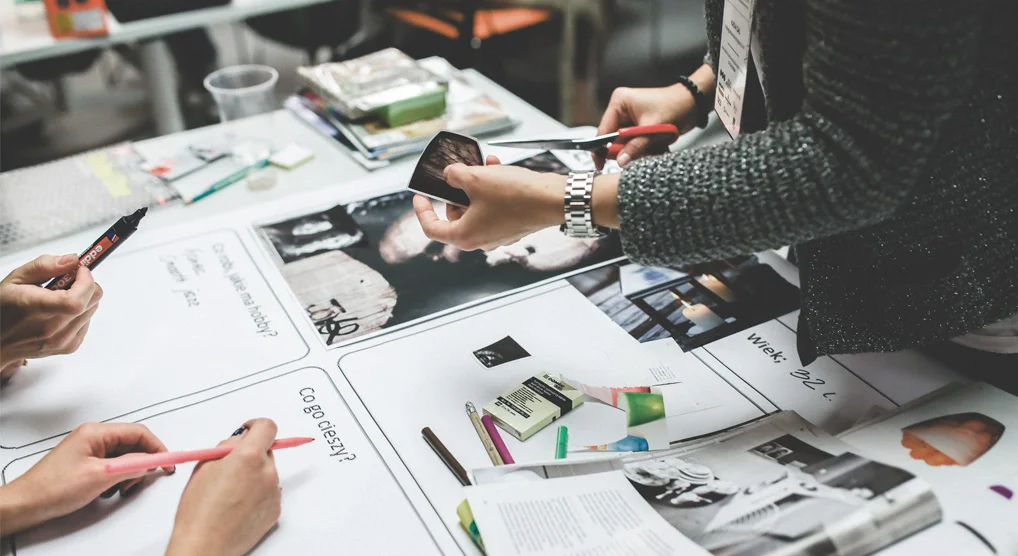
Innovation in the workplace cannot be discussed without mentioning design thinking. In fact, this approach is one of the key drivers of innovation within organizations, as it helps to rethink products and services from the user’s perspective.
On the other hand, this approach allows companies to break free from traditional molds and discover new growth opportunities. Consequently, the organization becomes more agile and adaptable to rapid market changes.
In addition, design thinking contributes to:
Improving customer experience
Accelerating product and service development
Enhancing team collaboration
Supporting data-driven decision-making
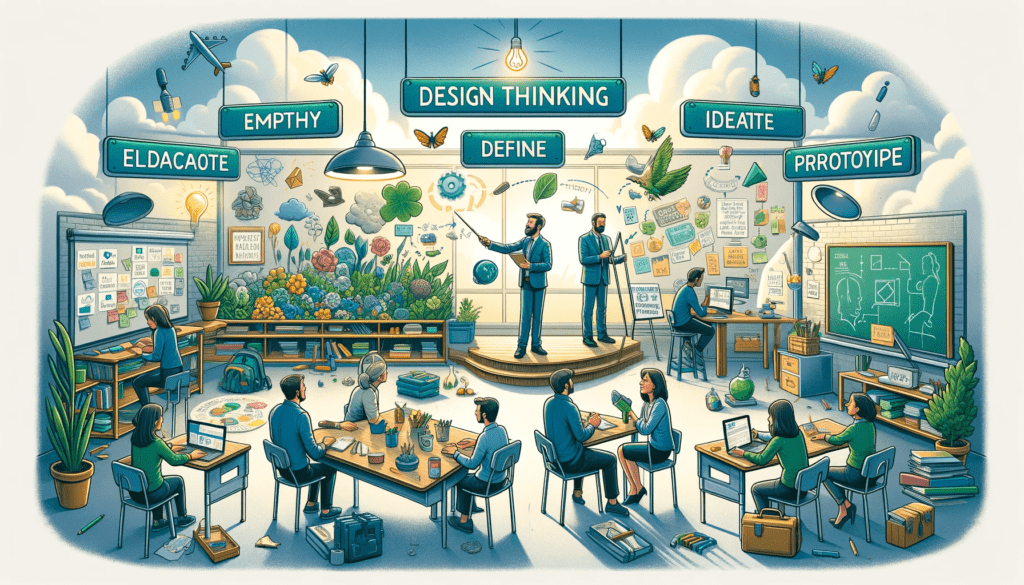
The five stages of design thinking in detail
Firstly: Empathize with the user
Initially, the design thinking journey begins with an empathy phase, which aims to deeply understand users. Through interviews, direct observation, and data analysis, teams can uncover the real challenges customers face.
In other words, empathy is not just about gathering information, but goes beyond that to understanding feelings and motivations. As a result, solutions become more accurate and appropriate.
Second: Defining the problem
Next comes the problem definition phase, where the insights gained are translated into a clear and specific formulation of the core challenge. It is important that the problem formulation be user-centric.
For example:
Instead of simply saying “decreased customer satisfaction,” one could ask the following question:
How can the customer experience be improved at different interaction points to increase their satisfaction and loyalty?
In this way, efforts are directed towards more innovative solutions.
Third: Generating ideas (Ideate)
At this stage, teams are encouraged to think freely. Unlike the traditional approach, ideas are not evaluated or rejected at this stage.
Furthermore, brainstorming sessions and creative thinking techniques help broaden the range of possible solutions. This, in turn, increases the chances of generating innovative and unexpected ideas.
Fourth: Rapid prototyping (Prototype)
After selecting the most promising ideas, they are turned into simple prototypes. The goal here is not to reach a final product, but to test the idea quickly.
Through these models, companies can:
Testing solutions in early stages
Reducing costs and risks
Collecting user feedback
Fifth: Testing and Repetition (Test)
Finally comes the testing phase, where prototypes are presented to real users. Based on their feedback, the solution is improved or reverted to earlier stages.
Therefore, this approach ensures continuous development and access to effective and sustainable solutions.

The importance of design thinking in the workplace
In general, applying design thinking achieves multiple strategic benefits, most notably:
Improving customer experience
When companies focus on user needs, they offer more appropriate solutions, and thus the level of satisfaction and loyalty increases.
Accelerating innovation
Thanks to rapid prototyping and continuous testing, the time required to develop products and services is reduced.
Strengthening internal cooperation
At the same time, this approach encourages teamwork and the exchange of experiences between different departments.
Practical applications of design thinking in organizations
In the banking sector
For example, many banks have used this approach to redesign branches and digital services. As a result, customer experience has improved and operational efficiency has increased.
In the technology sector
Likewise, technology companies rely on design thinking to develop products that are easy to use and focus on user experience.
In human resources
In addition, this approach is used to improve employee experience and build more motivating work environments.
Design thinking and its role in startups
Startups often face challenges related to resources and time. However, through Design Thinking, these challenges can be effectively overcome.
Therefore, this approach helps startups to:
Testing ideas quickly
Deep understanding of the target market
Reducing the chances of failure
Building products that meet customer needs
The impact of design thinking on company culture
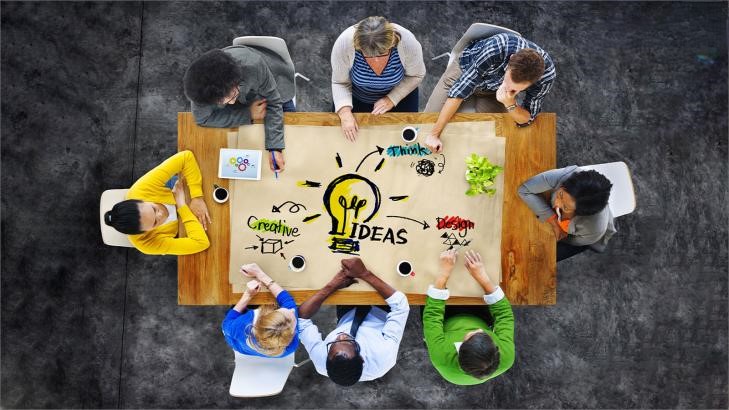
In addition to improving products and services, design thinking contributes to building an innovation-driven corporate culture. Over time, this leads to:
Promoting the spirit of initiative
Encouraging creativity
Improving communication between teams
Accept failure as part of learning
How does Reins help you apply design thinking?
At Reins, we believe that innovation in business begins with understanding people. Therefore, we offer specialized solutions and consulting to help companies effectively implement design thinking.
Reins helps you to:
Analyzing customer needs
Designing innovative solutions
Building workable prototypes
Establishing a culture of innovation within your organization
👉 Start your journey towards innovation with Reins today, and turn your ideas into tangible results.
Frequently Asked Questions about Design Thinking (FAQ)
What is design thinking?
It is an innovative, user-centered approach to problem-solving, based on experimentation and continuous testing.
Can it be applied in all sectors?
Yes, it can be used in education, health, technology, services, and more.
Is it suitable for small businesses?
Absolutely, it is an ideal tool for startups because of its flexibility and low cost.
What is its relationship to innovation?
Simply put, design thinking is one of the most important tools for achieving innovation at work.
How do I start applying it?
Teams can be trained internally, or experts like Reins can be brought in.
Design thinking as an approach to sustainable innovation
In conclusion, design thinking is no longer an optional extra, but a strategic necessity for any company seeking to innovate and achieve sustainable growth. By focusing on the user, continuously experimenting, and learning from mistakes, organizations can build effective solutions that make a real difference.
🚀 Connect with Reins now, and start your journey towards a more innovative future.